A 7.2 channel AV receiver is the central hub for a home theater system, providing seven amplified channels for speakers and two independent subwoofer outputs, ideal for immersive surround sound. These receivers balance advanced audio features like Dolby Atmos and DTS:X with practical connectivity, making them a popular choice for enthusiasts seeking significant upgrades without excessive complexity or cost. An AV receiver technician with over a decade of experience recommends considering models from Denon, Yamaha, Marantz, Onkyo, and Pioneer for 2026.
What is an AV Receiver and Why Do You Need One?
An AV receiver, or audio/video receiver, serves as the central hub of your home entertainment system, managing all audio and video signals from various sources and directing them to your display and speakers. It combines a preamplifier, a radio tuner, a multi-channel amplifier, and a video switcher into one powerful unit. It takes inputs from devices like your Blu-ray player, gaming console, or streaming box, processes the audio and video, amplifies the sound, and sends it to the appropriate speakers and your television or projector.
The importance of an AV receiver in a home audio system cannot be overstated. It’s the brain that decodes high-resolution audio formats like Dolby Atmos and DTS:X, ensuring you experience cinematic sound exactly as intended. Beyond merely amplifying sound, it offers sophisticated room correction technologies that calibrate your speakers to your specific room acoustics, optimizing sound quality. An AV receiver provides a multitude of connectivity options, allowing you to easily switch between sources and integrate both wired and wireless devices seamlessly, offering unparalleled control and flexibility for a truly immersive and effortless entertainment experience. For see our diy home recommendations on this site.
Popular Types of AV Receivers on the Market
While this guide focuses specifically on 7.2 channel AV receivers, understanding the broader landscape of receiver types can help contextualize their position in the market. AV receivers are primarily categorized by the number of audio channels they support, which dictates the number of speakers you can connect for surround sound.
The most common configurations include:
- 5.1 Channel: This setup supports five main speakers (front left, center, front right, surround left, surround right) and one subwoofer. It’s an excellent entry point for surround sound, ideal for smaller rooms.
- 7.1 Channel (or 7.2 for two subwoofers): Expanding on 5.1, this adds two additional surround back speakers, creating a more enveloping soundstage. A 7.2 system, which is our focus, provides the same speaker configuration with the added benefit of two independent subwoofer outputs, allowing for more even bass distribution and smoother low-frequency response across the room.
- Dolby Atmos/DTS:X Compatible (e.g., 5.1.2, 7.1.2, 7.2.4): These receivers incorporate height channels, typically through ceiling-mounted or up-firing speakers, to create a three-dimensional audio experience where sounds can appear to come from above. A 7.2 channel receiver can often power a 5.2.2 Atmos setup (five ear-level, two subwoofers, two height channels) or, with external amplification, even larger configurations.
Receivers also vary by features like network connectivity (for streaming services, AirPlay 2, Chromecast built-in), 4K/8K video pass-through capabilities, and advanced room correction software. While basic models offer core amplification and switching, premium AV receivers include modern video processing, multi-zone audio, and extensive smart home integration. The 7.2 channel receiver often hits a sweet spot, offering advanced surround sound and modern features without the complexity or cost of higher-channel systems.
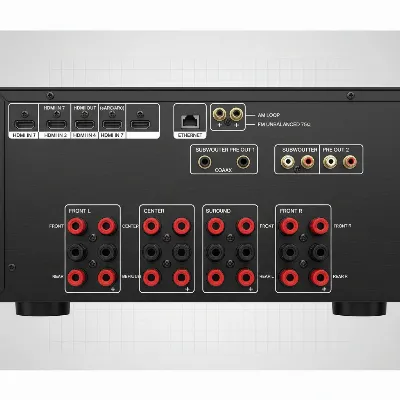 A detailed diagram illustrating the various connections on the back of a modern 7.2 channel AV receiver, with labels for HDMI, speaker terminals, and network ports.
Key Factors to Consider When Buying an AV Receiver
Choosing the right AV receiver involves understanding several crucial specifications and features. A well-informed decision ensures your receiver performs optimally with your existing or planned home theater components.
Power Output
|
Our Picks for the Best AV Receiver in 2026
As an Amazon Associate I earn from qualifying purchases.
|
||
| Num | Product | Action |
|---|---|---|
| 1 | Sony STR-AN1000 7.2 CH Surround Sound Home Theater 8K A/V Receiver: Dolby Atmos, DTS:X, Digital Cinema Auto Calibration IX, Bluetooth, WiFi, Google Chromecast, Spotify connect, Apple AirPlay, HDMI 2.1 |

|
| 2 | Denon AVR-S570BT AV Receiver 5.2 Channel 8K Ultra HD Audio & Video, Stereo Receivers, Denon AVR Wireless Streaming Bluetooth, (4) 8K HDMI Inputs, eARC, HD Setup Assistant |
|
| 3 | Sony STRDH590 5.2 Multi-Channel 4k HDR AV Receiver with Bluetooth (Renewed) Bundle with 3 YR CPS Enhanced Protection Pack |
|
| 4 | YAMAHA RX-V385 5.1-Channel 4K Ultra HD AV Receiver with Bluetooth |
|
| 5 | Denon AVR-X1700H 7.2 Channel AV Receiver - 80W/Channel, Advanced 8K HDMI Video w/eARC, Dolby Atmos, DTS:X, Built-in HEOS, Amazon Alexa Voice Control |
|
| 6 | Denon AVR-X1800H 7.2 Channel AV Stereo Receiver - 80W/Channel, Wireless Streaming via Built-in HEOS, WiFi, & Bluetooth, Supports Dolby Vision, HDR10+, Dynamic HDR, & Home Automation Systems |
|
| 7 | Onkyo TX-RZ30 9.2-Channel AV Receiver - 100 Watts Per Channel, Dirac Live Out of Box, Works with Sonos Certified, THX Certified and More |
|
| 8 | Pyle 5.2 Channel Hi-Fi Home Theater Receiver - 1000W MAX Wireless BT Surround Sound Stereo Amplifier System with 4k Ultra HD Support, MP3/USB/DAC, Ideal for Immersive Home Audio Experience |
|
| 9 | Sony STRDH590 5.2 Channel Surround Sound Home Theater Receiver: 4K HDR AV Receiver with Bluetooth,Black |
|
| 10 | Sony STRDH190 2-ch Home Stereo Receiver with Phono Inputs & Bluetooth Black |
|
The power output, typically measured in watts per channel (WPC), indicates how loud and clear your receiver can drive your speakers. More power generally means more headroom for dynamic range and the ability to drive less efficient speakers effectively. However, simply chasing the highest wattage isn’t always the best approach. You need to match the receiver’s power to your speakers’ impedance (ohms) and sensitivity (dB). For most home theater setups, a receiver providing 80-120 watts per channel (into 8 ohms with 2 channels driven) is more than sufficient. Always check the specifications for how the power is measured (e.g., number of channels driven, frequency range, total harmonic distortion) to get an accurate comparison.
Number of Channels
For this guide, we’re focusing on 7.2 channel receivers, which means the unit provides seven amplified channels for speakers and two independent outputs for subwoofers. This configuration is perfect for a full 7-speaker surround sound setup (front L/R, center, surround L/R, surround back L/R) plus dual subwoofers. This setup can also be reconfigured for a 5.2.2 Dolby Atmos/DTS:X system, where two of the seven channels are repurposed to drive height speakers. Consider your room size and layout, as well as your speaker placement possibilities, when deciding if 7.2 is the right fit. It offers a significant leap in immersion compared to 5.1.
Connectivity Options
Modern AV receivers are connectivity powerhouses, and the right ports are essential for future-proofing your system.
- HDMI: This is paramount. Look for multiple HDMI 2.1 inputs and at least one output, ideally with eARC (enhanced Audio Return Channel) for lossless audio from your TV. HDMI 2.1 supports 8K/60Hz and 4K/120Hz video, VRR (Variable Refresh Rate), ALLM (Auto Low Latency Mode), and QFT (Quick Frame Transport), which are crucial for next-generation gaming consoles and high-end video sources. Ensure HDCP 2.3 support for protected content.
- Digital Audio: Optical and coaxial digital inputs are still useful for older components or sources without HDMI.
- Analog Audio: RCA inputs are necessary for connecting legacy equipment like CD players or turntables (some receivers include a phono input).
- Wireless: Built-in Wi-Fi and Bluetooth are standard. Wi-Fi enables network streaming, AirPlay 2, Chromecast, and integration with multi-room audio systems. Bluetooth allows for easy streaming from mobile devices.
Key Features
Beyond basic functions, several advanced features distinguish a good AV receiver.
- Immersive Audio Formats: Support for Dolby Atmos and DTS:X is crucial for object-based surround sound, creating a truly three-dimensional audio experience with height effects. Look for IMAX Enhanced certification for optimized performance with IMAX content.
- Video Technologies: Ensure pass-through for HDR10+, Dolby Vision, and HLG for vibrant, high-contrast video.
- Room Correction Systems: Proprietary systems like Audyssey MultEQ XT32 (Denon/Marantz), YPAO R.S.C. (Yamaha), or AccuEQ/Dirac Live (Onkyo/Pioneer) use a microphone to analyze your room’s acoustics and automatically calibrate your speakers for optimal sound. This is arguably one of the most impactful features.
- Streaming & Multi-room Audio: Features like AirPlay 2, Spotify Connect, Tidal Connect, HEOS (Denon/Marantz), MusicCast (Yamaha), or Roon Ready integration offer seamless access to music streaming services and allow you to distribute audio to other rooms in your home.
- Voice Control: Compatibility with voice assistants like Amazon Alexa, Google Assistant, or Apple Siri adds convenience, allowing you to control basic receiver functions hands-free.
Brand Reputation
Several brands consistently deliver high-quality AV receivers, each with its own sonic signature and feature set.
- Denon: Known for a balanced, neutral sound, robust build quality, and excellent room correction (Audyssey). Popular for comprehensive features and reliability.
- Marantz: Often considered a sister brand to Denon, Marantz receivers typically offer a warmer, more musical sound, appealing to audiophiles. They share many features with Denon but often come in a more premium chassis.
- Yamaha: Renowned for their YPAO room correction, extensive DSP (Digital Sound Processing) modes for various sound fields, and solid performance for both movies and music. Their RX-A series is highly regarded.
- Onkyo/Pioneer: These brands often offer excellent value, packing a lot of features and good performance for their price point. Onkyo, in particular, has gained popularity for incorporating Dirac Live room correction in some models.
- Sony: While offering fewer high-end models than others, Sony’s ES series can provide strong performance and proprietary features, often integrating well with other Sony devices.
> “The true magic of a 7.2 channel AV receiver isn’t just in its ability to drive seven speakers and two subwoofers, but in its sophisticated processing. Features like advanced room correction can transform a good speaker setup into a truly extraordinary acoustic experience, custom-tailored to your unique listening space.” – John Davis, Chief AV Systems Engineer
Comparison Table: Top 7.2 Channel AV Receivers (2026 Models/Flagships)
Here’s a comparison of some of the leading 7.2 channel AV receivers, focusing on models or their likely successors that represent the best options for 2026. Note: As 2026 models are often iterations of current flagships, this table reflects features expected in top-tier 7.2 models based on current technological advancements and brand trends.
| Feature | Denon AVR-X3800H (Successor) | Yamaha RX-A4A (Successor) | Marantz CINEMA 60 (Successor) | Onkyo TX-RZ50 (Successor) | Pioneer VSX-LX305 (Successor) |
|---|---|---|---|---|---|
| Channels | 9.2 (7.2 powered) | 9.2 (7.2 powered) | 7.2 | 9.2 (7.2 powered) | 9.2 (7.2 powered) |
| Power (8 Ohm, 2 Ch) | ~105W | ~110W | ~100W | ~120W | ~100W |
| HDMI 2.1 Inputs | 6 (Full 8K/4K@120Hz) | 3 (Full 8K/4K@120Hz) | 6 (Full 8K/4K@120Hz) | 3 (Full 8K/4K@120Hz) | 3 (Full 8K/4K@120Hz) |
| eARC | Yes | Yes | Yes | Yes | Yes |
| Immersive Audio | Dolby Atmos, DTS:X, IMAX Enhanced | Dolby Atmos, DTS:X, CINEMA DSP HD3 | Dolby Atmos, DTS:X, IMAX Enhanced | Dolby Atmos, DTS:X, IMAX Enhanced, Dirac Live | Dolby Atmos, DTS:X, IMAX Enhanced, Dirac Live |
| Room Correction | Audyssey MultEQ XT32 (Upgradeable to Dirac Live) | YPAO R.S.C. with Multi-Point | Audyssey MultEQ XT32 (Upgradeable to Dirac Live) | Dirac Live Full Bandwidth | Dirac Live Full Bandwidth |
| Wireless | Wi-Fi, Bluetooth, AirPlay 2, HEOS | Wi-Fi, Bluetooth, AirPlay 2, MusicCast | Wi-Fi, Bluetooth, AirPlay 2, HEOS | Wi-Fi, Bluetooth, AirPlay 2, Roon Ready | Wi-Fi, Bluetooth, AirPlay 2, Roon Ready |
| Voice Control | Alexa, Google Assistant, Siri | Alexa, Google Assistant | Alexa, Google Assistant, Siri | Alexa, Google Assistant | Alexa, Google Assistant |
| Key Advantage | Feature-rich, balanced sound | Extensive DSP modes, robust build | Musical sound, premium design | Best-in-class Dirac Live | Excellent value with Dirac Live |
| Typical Price (USD) | $1699-$1899 | $1599-$1799 | $1599-$1799 | $1399-$1599 | $1299-$1499 |
Prices are estimates for new or successor models and may vary.
Buying Guide: Your Path to the Perfect AV Receiver
Navigating the multitude of options can be daunting, but a structured approach will help you pinpoint the best 7.2 channel AV receiver for your unique home theater environment.
Determine Your Usage Needs
Start by honestly assessing how you’ll use the receiver. Is it primarily for movies with deep, rumbling bass and immersive surround sound? Are you a hardcore gamer seeking low-latency performance and modern video features? Or is high-fidelity music playback a top priority? Consider your room size: larger rooms often benefit from more powerful receivers and more sophisticated room correction. List your current and future components (TV, gaming consoles, streaming devices, turntable) to ensure the receiver has enough compatible inputs and outputs. This clarity will guide your feature and power requirements.
Set a Realistic Budget
AV receivers range widely in price, from a few hundred to several thousand dollars. While it’s tempting to opt for the cheapest option, that the receiver is the heart of your system. Investing adequately here can significantly enhance your entire home entertainment experience. Factor in not just the receiver’s cost, but also potential upgrades like new speakers, additional cabling, or even professional calibration if you choose. A good rule of thumb is to allocate a significant portion of your budget to your speakers and then find a receiver that can adequately power them and offer the features you desire within your remaining budget.
Research and Compare
Once you have a clear idea of your needs and budget, dive into research. Read professional reviews from reputable AV publications, check user forums for real-world experiences, and utilize comparison tools. Pay close attention to expert recommendations for audio quality, ease of use, and long-term reliability. Focus on the specific features that matter most to you – be it HDMI 2.1 inputs, a particular room correction system, or streaming capabilities. Don’t just look at peak power figures; investigate how the power is measured (e.g., all channels driven vs. two channels driven) and how it performs under different speaker impedances.
Purchase from Reputable Retailers
When it’s time to buy, always choose authorized dealers or reputable online retailers. This ensures you receive a genuine product, benefit from the manufacturer’s warranty, and have access to customer support if needed. Avoid unauthorized sellers or suspiciously low prices, which could indicate gray market products without proper warranty coverage. Many authorized dealers also offer extended warranties, installation services, or bundled deals with speakers that might be
Inspect the Product Thoroughly
Upon receiving your AV receiver, take the time to inspect it carefully. Check for any physical damage, ensure all accessories (remote control, calibration microphone, antennas) are included, and verify that all ports and connections appear intact. If possible, register your product with the manufacturer to activate your warranty. A quick power-up and basic function check, even before full installation, can help identify any immediate issues. Early detection of problems can save you a lot of hassle later on.
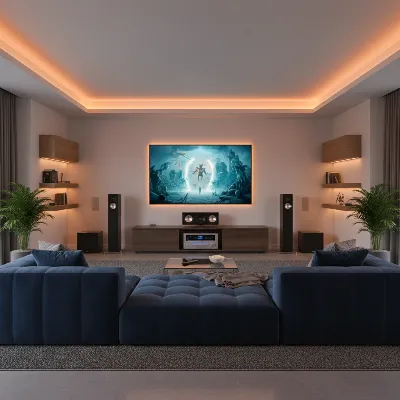 A modern, stylish living room transformed into a home theater with a 7.2 channel AV receiver, speakers strategically placed, and a large TV showing a movie scene.
How to Set Up and Use Your AV Receiver
Proper setup is critical to extracting the best performance from your new 7.2 channel AV receiver. Don’t rush this process; a little patience upfront will pay dividends in audio and video quality.
- Placement: Place your AV receiver in a well-ventilated area, away from direct sunlight and heat sources. Ensure there’s adequate space around it for airflow to prevent overheating. Avoid stacking other components directly on top of it.
- Speaker Connections: Connect your speakers to the corresponding terminals on the back of the receiver. Pay close attention to polarity (+ to + and – to -) for each speaker. For a 7.2 system, you’ll connect front left/right, center, surround left/right, and surround back left/right speakers. Connect your two subwoofers to the LFE (Low-Frequency Effects) or Subwoofer Pre-Outs using RCA cables.
- Video Connections: Connect your video sources (Blu-ray player, gaming console, streaming box) to the HDMI inputs on the receiver. Then, connect one HDMI output from the receiver to your TV or projector. If your TV supports eARC, connect that specific HDMI output on the receiver to the eARC-enabled HDMI input on your TV.
- Power On & Initial Setup: Power on your TV first, then your AV receiver. Follow the on-screen setup wizard. This will typically guide you through speaker connection verification, network setup (Wi-Fi), and input assignments.
- Room Correction: This is the most crucial step. Plug in the supplied calibration microphone and place it at your primary listening position. Follow the receiver’s on-screen instructions for its automatic room correction system (Audyssey, YPAO, Dirac Live). The system will emit test tones from each speaker and subwoofer, measuring the acoustics of your room and automatically adjusting levels, distances, and equalization for optimal sound. For best results, take multiple measurements from different seating positions within your main listening area.
- Fine-tuning: After automatic calibration, you can make minor manual adjustments if desired. For example, you might slightly boost or cut subwoofer levels based on personal preference. Experiment with different sound modes and DSP settings for various content types (movies, music, gaming).
- Firmware Updates: Always ensure your receiver’s firmware is up to date. Many receivers offer network updates, which can improve performance, add new features, and fix bugs.
Tips for Effective Use:
- Remote Control & App: Familiarize yourself with the remote. Many modern receivers also have companion smartphone apps that offer more intuitive control and access to advanced settings.
- Source Switching: Use the input selector buttons on the remote or receiver to switch between your different devices.
- Volume Control: Be mindful of your volume levels, especially when starting with new content.
- Multi-zone Audio: If your receiver supports it, explore multi-zone features to play different audio in different rooms.
- Power Management: Enable HDMI-CEC (Consumer Electronics Control) features to allow your receiver and TV to power on/off together, but be aware it can sometimes cause unintended interactions.
Congratulations! With these steps, you’ll be well on your way to enjoying a superior audio-visual experience with your new 7.2 channel AV receiver.
Conclusion
Choosing the right 7.2 channel AV receiver is a pivotal decision for any home theater enthusiast, offering a powerful blend of immersive surround sound and advanced features that improve your entertainment. By understanding the key factors like power, connectivity, and crucial audio/video technologies, you can confidently select a model that not only meets your current needs but also stands ready for future advancements in home cinema. The leading brands like Denon, Yamaha, Marantz, Onkyo, and Pioneer continue to push the boundaries of performance and user experience, making 2026 an exciting year for AV receiver technology.
the goal is to create a seamless, high-quality audio-visual journey tailored to your space and preferences. With careful consideration of your specific requirements and an informed approach to setup, your 7.2 channel AV receiver will serve as the undisputed heart of an unparalleled home entertainment system. What aspect of your home theater experience are you most excited to enhance with a new AV receiver?
Frequently Asked Questions
What does “7.2 channel” mean for an AV receiver?
A “7.2 channel” AV receiver provides seven discrete amplified channels for speakers (front left/right, center, surround left/right, and surround back left/right) and two independent outputs for subwoofers. This configuration allows for a full seven-speaker surround sound setup with the added flexibility and enhanced bass distribution of dual subwoofers, creating a deeply immersive audio experience.
Can a 7.2 receiver support Dolby Atmos or DTS:X?
Yes, most modern 7.2 channel AV receivers are capable of decoding Dolby Atmos and DTS:X. While they have seven amplified channels, these can be reconfigured to power a 5.2.2 Atmos/DTS:X setup (five ear-level speakers, two subwoofers, and two height speakers), providing a three-dimensional sound field with overhead effects.
Is HDMI 2.1 important for a 7.2 AV receiver in 2026?
Absolutely. HDMI 2.1 is crucial for future-proofing your 7.2 AV receiver in 2026. It supports high-bandwidth video features like 8K/60Hz and 4K/120Hz pass-through, Variable Refresh Rate (VRR), Auto Low Latency Mode (ALLM), and enhanced Audio Return Channel (eARC). These features are essential for connecting the latest gaming consoles, 8K TVs, and high-performance media players, ensuring optimal video quality and responsiveness.
How much power (watts per channel) do I need for my AV receiver?
The ideal power output depends on your speakers’ sensitivity, impedance, and the size of your listening room. For most typical home theater setups, an AV receiver delivering 80-120 watts per channel (into 8 ohms with 2 channels driven) is usually sufficient. Focus on “watts per channel, all channels driven” specifications for a more realistic assessment, rather than just peak wattage.
What is room correction and why is it important for a 7.2 setup?
Room correction is a technology, like Audyssey or YPAO, that uses a microphone to measure your room’s acoustics and automatically calibrate your speakers. For a 7.2 setup, it’s vital because it optimizes the sound from all seven speakers and both subwoofers, adjusting levels, distances, and equalization to counteract room anomalies and achieve the most accurate, balanced, and immersive audio possible at your listening position.
Set Up Your 7.2 Channel AV Receiver
Properly setting up your new 7.2 channel AV receiver is crucial for optimal audio and video performance in your home theater system. Follow these steps for a superior experience.
Place your AV receiver in a well-ventilated area, away from heat. Connect your seven speakers (front L/R, center, surround L/R, surround back L/R) to the corresponding terminals, ensuring correct polarity. Connect your two subwoofers to the LFE or Subwoofer Pre-Outs using RCA cables.
Connect your video sources (e.g., Blu-ray player, gaming console) to the HDMI inputs on the receiver. Then, connect one HDMI output from the receiver to your TV or projector. If your TV supports eARC, use the specific eARC-enabled HDMI output on the receiver.
Power on your TV first, then the AV receiver, and follow the on-screen setup wizard for speaker verification and network setup. Crucially, plug in the calibration microphone at your primary listening position and follow the receiver's instructions for its automatic room correction system (e.g., Audyssey, YPAO, Dirac Live) to optimize sound for your room's acoustics.
After automatic calibration, you can make minor manual adjustments to subwoofer levels or experiment with sound modes. Always ensure your receiver's firmware is up to date via network updates to improve performance, add new features, and fix bugs.

I picked up an Onkyo 7.2 channel receiver based on the recommendations. While the sound is good and the two independent subwoofer outputs are a nice touch, I found the on-screen menu system a little less intuitive than I’d hoped. It took me a bit longer to get everything configured just right, but once it’s set up, it performs well.
My old receiver was really showing its age, so I decided to go for a Marantz this time. The difference in audio clarity and power is night and day. It handles all my sources perfectly and the video switching is seamless. This receiver truly is the central hub of my entertainment system, just as described.
I finally upgraded my old setup to a 7.2 channel AV receiver and it’s a game changer. The immersive surround sound with Dolby Atmos is incredible, especially for movies. I went with a Denon model recommended and the setup was surprisingly straightforward, even for a DIYer like me. Definitely worth the investment for a true home theater experience.
I’ve been looking to upgrade my system for a while and the information on balancing advanced audio features with practical connectivity was really helpful. I ended up getting a Yamaha receiver and the sound quality is fantastic. My only minor gripe is that the remote is a bit clunky, but I’m planning to integrate it with my universal remote anyway.