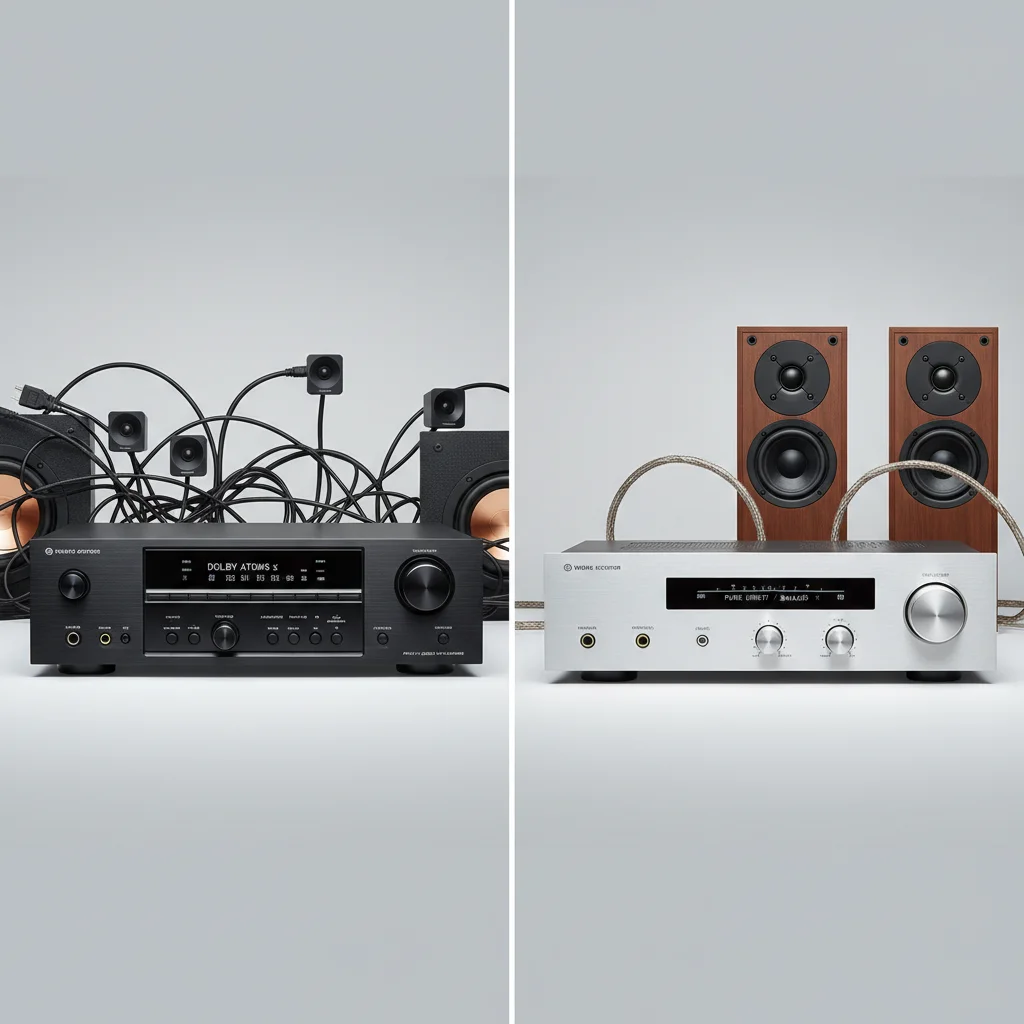
Choosing between an AV receiver and a stereo receiver can significantly impact your home audio experience. While both amplify sound, an AV receiver is designed for multi-channel home theater setups, typically supporting 5.1, 7.1, or even 9.2 channels, whereas a stereo receiver is optimized for two-channel audio, focusing on pure musical fidelity. The right choice depends entirely on your primary use case: movies and surround sound demand an AV receiver, while critical music listening often benefits from a stereo receiver’s dedicated two-channel amplification.
Understanding AV Receivers for Home Theater
AV receivers are the central hub of any home theater system. They decode various audio formats like Dolby Atmos and DTS:X, manage video signals from multiple sources (Blu-ray players, gaming consoles, streaming devices), and distribute power to numerous speakers, including a subwoofer. Modern AV receivers often feature advanced connectivity options such as HDMI 2.1 for 8K video passthrough, Wi-Fi, Bluetooth, and multi-room audio capabilities. Their primary strength lies in creating an immersive, cinematic soundstage with discrete channels for dialogue, effects, and music.
However, this versatility comes with complexity. Setting up an AV receiver involves calibrating multiple speakers, managing video inputs, and navigating extensive menu systems. While they excel at surround sound, some audiophiles argue that their multi-channel design can compromise the purity of two-channel music playback compared to dedicated stereo units.
The Simplicity and Purity of Stereo Receivers
Stereo receivers, by contrast, are built with a singular focus: delivering high-quality two-channel audio. They typically feature a powerful amplifier section for two speakers (left and right) and a tuner for radio. While some modern stereo receivers include digital inputs, Bluetooth, or even network streaming, their core design prioritizes signal integrity and minimal interference for music reproduction. This streamlined approach often results in a cleaner, more detailed soundstage for stereo recordings.
For listeners whose primary interest is music—whether from vinyl, CDs, or high-resolution digital files—a stereo receiver can offer superior performance for the money. They are generally simpler to set up and operate, making them an excellent choice for dedicated music rooms or smaller living spaces where a full surround sound system is impractical.
Key Differences in Connectivity and Features
|
Our Picks for the Best AV Receiver in 2026
As an Amazon Associate I earn from qualifying purchases.
|
||
| Num | Product | Action |
|---|---|---|
| 1 | Sony STRDH190 2-ch Home Stereo Receiver with Phono Inputs & Bluetooth Black |

|
| 2 | Denon AVR-X1700H 7.2 Channel AV Receiver - 80W/Channel, Advanced 8K HDMI Video w/eARC, Dolby Atmos, DTS:X, Built-in HEOS, Amazon Alexa Voice Control |
|
| 3 | Denon AVR-S570BT AV Receiver 5.2 Channel 8K Ultra HD Audio & Video, Stereo Receivers, Denon AVR Wireless Streaming Bluetooth, (4) 8K HDMI Inputs, eARC, HD Setup Assistant |
|
| 4 | Denon AVR-X1800H 7.2 Channel AV Stereo Receiver - 80W/Channel, Wireless Streaming via Built-in HEOS, WiFi, & Bluetooth, Supports Dolby Vision, HDR10+, Dynamic HDR, & Home Automation Systems |
|
| 5 | Sony STR-AN1000 7.2 CH Surround Sound Home Theater 8K A/V Receiver: Dolby Atmos, DTS:X, Digital Cinema Auto Calibration IX, Bluetooth, WiFi, Google Chromecast, Spotify connect, Apple AirPlay, HDMI 2.1 |
|
| 6 | YAMAHA RX-V385 5.1-Channel 4K Ultra HD AV Receiver with Bluetooth |
|
| 7 | Pyle 5.2 Channel Hi-Fi Home Theater Receiver - 1000W MAX Wireless BT Surround Sound Stereo Amplifier System with 4k Ultra HD Support, MP3/USB/DAC, Ideal for Immersive Home Audio Experience |
|
| 8 | Sony STRDH590 5.2 Channel Surround Sound Home Theater Receiver: 4K HDR AV Receiver with Bluetooth,Black |
|
| 9 | Sony STRDH590 5.2 Multi-Channel 4k HDR AV Receiver with Bluetooth (Renewed) Bundle with 3 YR CPS Enhanced Protection Pack |
|
| 10 | Onkyo TX-RZ30 9.2-Channel AV Receiver - 100 Watts Per Channel, Dirac Live Out of Box, Works with Sonos Certified, THX Certified and More |
|
The most significant divergence between these two receiver types lies in their input/output options and feature sets. AV receivers boast multiple HDMI inputs and outputs, optical and coaxial digital inputs, and often component or composite video inputs for legacy devices. They also include pre-outs for external amplifiers, multi-zone audio capabilities, and advanced room correction software like Audyssey or YPAO.
Stereo receivers, while simpler, still offer essential connectivity for music lovers. You’ll typically find multiple analog RCA inputs for turntables (often with a built-in phono stage), CD players, and other audio sources. Some higher-end models may include a USB DAC for computer audio or network streaming features, but video switching is almost universally absent. The focus remains on audio signal paths.
When to Choose Which Receiver Type
The decision ultimately hinges on your priorities:
- Choose an AV Receiver if: You want a full home theater experience with surround sound, plan to connect multiple video sources, need advanced audio decoding (Dolby Atmos, DTS:X), or desire multi-room audio capabilities.
- Choose a Stereo Receiver if: Your primary focus is high-fidelity music listening, you prefer a simpler setup, you have a dedicated two-channel audio system, or space constraints limit a multi-speaker setup.
- Consider a Hybrid Approach: Some audiophiles use a stereo receiver for music and an AV receiver for movies, or integrate a stereo amplifier into an AV receiver’s pre-outs for critical front-channel music playback.
Performance and Budget Considerations
Generally, for a given budget, a stereo receiver will often provide more power and higher-quality amplification per channel than an AV receiver, simply because it has fewer channels to power and fewer complex features to integrate. This can translate to better sound quality for music. However, AV receivers offer unparalleled value for their multi-channel capabilities and feature sets, making them indispensable for home theater enthusiasts.
When evaluating performance, consider the total harmonic distortion (THD), signal-to-noise ratio (SNR), and power output (watts per channel). For AV receivers, also look at the supported audio formats and video passthrough capabilities. For stereo receivers, the quality of the phono stage and DAC (if included) can be crucial.
