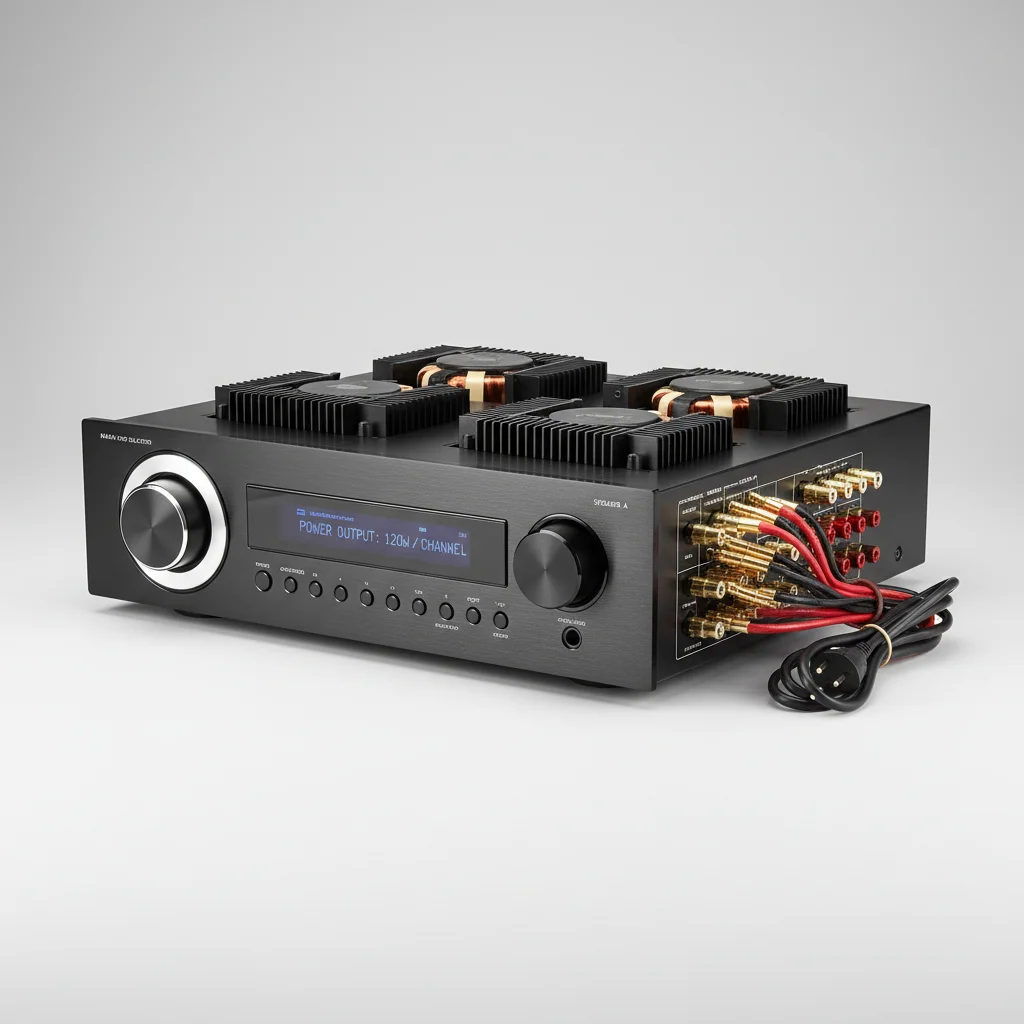
Determining the ideal AV receiver power output for your home theater system depends on several factors, but generally, a receiver with 80 to 120 watts per channel is sufficient for most average-sized living rooms and speaker setups. This range provides ample headroom for dynamic movie soundtracks and music without overdriving your speakers or requiring excessive volume levels. Factors like speaker sensitivity, room size, and listening preferences all play a crucial role in pinpointing the exact wattage you’ll need for an optimal audio experience.
Understanding Watts Per Channel (WPC)
Watts per channel (WPC) is a common specification for AV receivers, indicating the amount of power the receiver can deliver to each speaker. However, this number alone doesn’t tell the whole story. Manufacturers often measure WPC under different conditions, such as with one channel driven, two channels driven, or across the full frequency range. For a more accurate comparison, look for ratings that specify power output with two channels driven, a wide frequency response (e.g., 20 Hz to 20 kHz), and a low total harmonic distortion (THD) percentage (e.g., 0.08%). For best diy home roundups on this site.
Higher WPC doesn’t automatically equate to better sound quality. A receiver with a modest but clean power output can often sound better than a high-wattage receiver with poor amplification. The quality of the amplifier circuitry and power supply within the receiver significantly impacts the overall audio fidelity.
Speaker Sensitivity and Room Size
Speaker sensitivity, measured in decibels (dB), indicates how efficiently a speaker converts amplifier power into sound. A speaker with a higher sensitivity rating (e.g., 90 dB) will produce a louder sound with less power compared to a speaker with lower sensitivity (e.g., 85 dB). If you have highly sensitive speakers, you may not need an AV receiver with extremely high power output. Conversely, less sensitive speakers will benefit from more power to achieve the same volume levels.
The size of your listening room also dictates power requirements. Larger rooms require more power to fill the space with sound effectively. In a small apartment living room, 50-70 watts per channel might be perfectly adequate, while a dedicated home theater in a spacious basement could benefit from 100-150 watts per channel or more. Consider the volume at which you typically listen; if you prefer very loud playback, more power will provide greater dynamic range and prevent clipping.
Matching Power to Your Speakers
|
Our Picks for the Best AV Receiver in 2026
As an Amazon Associate I earn from qualifying purchases.
|
||
| Num | Product | Action |
|---|---|---|
| 1 | Pyle 5.2 Channel Hi-Fi Home Theater Receiver - 1000W MAX Wireless BT Surround Sound Stereo Amplifier System with 4k Ultra HD Support, MP3/USB/DAC, Ideal for Immersive Home Audio Experience |

|
| 2 | Sony STRDH190 2-ch Home Stereo Receiver with Phono Inputs & Bluetooth Black |
|
| 3 | YAMAHA RX-V385 5.1-Channel 4K Ultra HD AV Receiver with Bluetooth |
|
| 4 | Denon AVR-S570BT AV Receiver 5.2 Channel 8K Ultra HD Audio & Video, Stereo Receivers, Denon AVR Wireless Streaming Bluetooth, (4) 8K HDMI Inputs, eARC, HD Setup Assistant |
|
| 5 | Sony STRDH590 5.2 Channel Surround Sound Home Theater Receiver: 4K HDR AV Receiver with Bluetooth,Black |
|
| 6 | Sony STRDH590 5.2 Multi-Channel 4k HDR AV Receiver with Bluetooth (Renewed) Bundle with 3 YR CPS Enhanced Protection Pack |
|
| 7 | Onkyo TX-RZ30 9.2-Channel AV Receiver - 100 Watts Per Channel, Dirac Live Out of Box, Works with Sonos Certified, THX Certified and More |
|
| 8 | Denon AVR-X1800H 7.2 Channel AV Stereo Receiver - 80W/Channel, Wireless Streaming via Built-in HEOS, WiFi, & Bluetooth, Supports Dolby Vision, HDR10+, Dynamic HDR, & Home Automation Systems |
|
| 9 | Sony STR-AN1000 7.2 CH Surround Sound Home Theater 8K A/V Receiver: Dolby Atmos, DTS:X, Digital Cinema Auto Calibration IX, Bluetooth, WiFi, Google Chromecast, Spotify connect, Apple AirPlay, HDMI 2.1 |
|
| 10 | Denon AVR-X1700H 7.2 Channel AV Receiver - 80W/Channel, Advanced 8K HDMI Video w/eARC, Dolby Atmos, DTS:X, Built-in HEOS, Amazon Alexa Voice Control |
|
It’s crucial to match your AV receiver’s power output to your speakers’ recommended power handling range. Most speakers specify a minimum and maximum wattage they can safely handle. While it’s generally safer to have a receiver with slightly more power than your speakers’ minimum rating, avoid significantly overpowering them, as this can lead to damage. Underpowering speakers can also be detrimental, as a struggling amplifier can introduce distortion and clipping, which can be just as harmful as too much power.
When in doubt, consult your speaker’s manual for their recommended amplifier power. A good rule of thumb is to aim for an AV receiver whose continuous power output falls within the middle of your speakers’ recommended power handling range. This provides flexibility for both quiet and loud listening without pushing either component to its limits.
Benefits of Sufficient Power Output
- Improved Dynamics: Ample power allows the receiver to reproduce sudden, loud sounds (like explosions in movies) without strain or distortion.
- Clearer Sound at Higher Volumes: With enough power, your system can maintain clarity and detail even when you turn up the volume.
- Better Bass Response: Sufficient power helps control speaker drivers, leading to tighter, more impactful bass.
- Reduced Risk of Clipping: An underpowered amplifier pushed too hard can ‘clip’ the audio waveform, causing harsh distortion and potentially damaging speakers.
- Future-Proofing: A receiver with a bit more power than you currently need offers flexibility if you upgrade to less sensitive speakers or move to a larger room.
For a reliable AV receiver with excellent power delivery, consider the. It offers a robust 100 watts per channel, making it suitable for a wide range of home theater setups and speaker sensitivities. Its advanced amplification circuitry ensures clean, dynamic sound reproduction across all channels.
When More Power Isn’t Necessarily Better
While sufficient power is important, there’s a point of diminishing returns. Doubling the amplifier power only results in a 3 dB increase in volume, which is barely perceptible to the human ear. To achieve a noticeable increase in loudness, you’d need significantly more power. For example, to make your system sound twice as loud, you’d need ten times the power. Therefore, chasing extremely high wattage numbers beyond what your speakers and room require often leads to unnecessary expense without a proportional improvement in sound quality.
Focus instead on the overall quality of the receiver’s amplification, its features, and how well it integrates with your existing components. A well-engineered 80-watt receiver can often outperform a poorly designed 150-watt model. For those seeking a balance of power and advanced features, theis an excellent choice, providing 90 watts per channel with exceptional clarity and a comprehensive suite of connectivity options.

Good overview, but I wish there was a bit more detail on how different speaker impedances affect the actual power delivery. I have some older 6-ohm speakers and it’s always a bit of a guessing game. The general advice about 80-120 watts per channel is a solid starting point though for most people.
I was always confused about WPC ratings, but this really cleared things up. My old receiver was only 60 watts per channel and I thought I needed something massive. Turns out, my speakers are pretty sensitive, and upgrading to a 100WPC unit made a huge difference without breaking the bank. The sound is so much fuller now, especially during action scenes.
This was super helpful in understanding why my current receiver felt underpowered. I have a medium-sized room but love really dynamic movie soundtracks, and my old unit just wasn’t cutting it. Realized I needed more than the basic 70WPC. Upgraded to a 110WPC model and the difference in bass response and overall impact is incredible. No more clipping!
Great info here! I was debating between an 80-watt and a 120-watt receiver for my new setup. After reading this, I went with the 120WPC and I’m glad I did. My living room is on the larger side, and it gives me that extra headroom for movies without feeling like I’m pushing the system too hard. Definitely a noticeable improvement in clarity.